How to Discover If You Already Have A Life Insurance Policy
The short version
Insurance can feel like a wall of jargon. It doesn't have to be.
If you're reading this, chances are you're trying to make a careful decision — not chase the lowest sticker price. Good. Coverage that fits your life is worth taking your time on.
Here's the short version, in plain Canadian English. We'll walk through the parts that actually matter and skip the fine print that doesn't.
This guide walks through how to discover if you already have a life insurance policy the way a careful Canadian advisor would — one decision at a time, no scare tactics, no jargon you'd need to look up.
How to compare quotes properly
Two quotes for the same person can differ by 30% or more. The cause is almost never fraud — it's how each insurer prices the same risk based on their own underwriting models, reinsurance arrangements, and book of business.
When you compare, line up identical coverage amounts, identical term lengths, identical riders, and identical health classes. Premium alone is meaningless without that. A $32/month quote with a $25,000 coverage cap is not better than a $34/month quote with $500,000.
It also pays to look past the headline number. Conversion privileges, renewal terms, the financial strength of the insurer, and the speed of claim payment all matter — and none of them show up in the monthly premium.
Free, private, no credit check. Average savings: $480/year.
What it actually is
Life insurance sounds technical, but the idea is simple: you pay a regular premium and, in return, an insurer takes on a financial risk you couldn't carry alone.
That's the whole bargain. Everything else — riders, exclusions, conversion options, dividend scales — is a variation on that single trade. The trick is matching the variation to the life you actually live, not the life a brochure imagines.
Once you see it that way, comparing policies becomes a lot less intimidating. You're not picking a financial product so much as deciding which risks you'd rather not carry yourself.
Most Canadians end up with a small handful of plans across their lifetime — one to cover the years their income is replacing things, one to cover the years their estate is. Each does one thing well.
“Buy enough. Buy early. Keep it simple.”
Mistakes worth avoiding
The most expensive mistake isn't paying too much. It's buying too little, or buying coverage that ends right before you need it most. A 10-year term that expires the year your child starts university is a classic example — cheap, but cheap in the wrong way.
The second most expensive mistake is letting a single agent show you a single quote. Insurers price the same person very differently. Comparing three quotes from independent insurers is the simplest, lowest-effort way to avoid overpaying for two decades.
Most of the rest of the common mistakes look small at the time and big later. A short list:
- Naming an estate as beneficiary (slows payout, triggers probate)
- Skipping the medical exam to “save time” when it would have lowered your rate
- Letting a term policy expire instead of converting it
- Forgetting to update beneficiaries after a marriage, divorce, or new child
- Choosing the lowest premium without checking the conversion privilege
Why it matters in Canada
Canadian families don't usually go bankrupt from one big bill. They get there from the small, ongoing pressure of a missing income — a mortgage that still shows up every month, groceries, child care, the unglamorous middle of life.
Life insurance is designed to absorb that pressure so the people you love don't have to make sudden, hard choices on the worst week of their year. It buys time, and time is what most grieving families say they wished they had more of.
Public coverage helps with some of this. Provincial healthcare, CPP survivor benefits, and group benefits at work all play a role — but the gaps are often bigger than people expect, especially for self-employed Canadians and newcomers without a long Canadian work history.
Private coverage fills those gaps. It's not glamorous. It's a quiet line item that keeps a household stable when something loud happens.
A few myths, cleared up
It's not too expensive — most healthy 30-somethings can cover a $500,000 term policy for less than a streaming subscription. The “unaffordable” reputation comes from quotes given to people in their 50s after years of waiting; early applicants almost always describe the premium as a pleasant surprise.
Workplace coverage usually isn't enough on its own. It ends when the job does, the coverage amount is often a fraction of what's actually needed, and you can't take it with you. Treat it as a bonus, not a foundation.
You don't have to pass a medical exam for every policy. Several Canadian insurers issue coverage with a short questionnaire and no needles, especially for moderate coverage amounts and applicants under 50.
Where to go from here
There's no perfect policy. There's only the one that fits the people you love. Start with three quotes, side by side, and go from there.
How to check whether you already hold a policy
Sometimes the question isn't which policy to buy — it's whether one already exists. People forget coverage they signed up for years ago, or inherit the job of sorting out a parent's affairs and have no idea where to start. The good news: there's a fairly reliable order to work through, and most of it costs nothing.
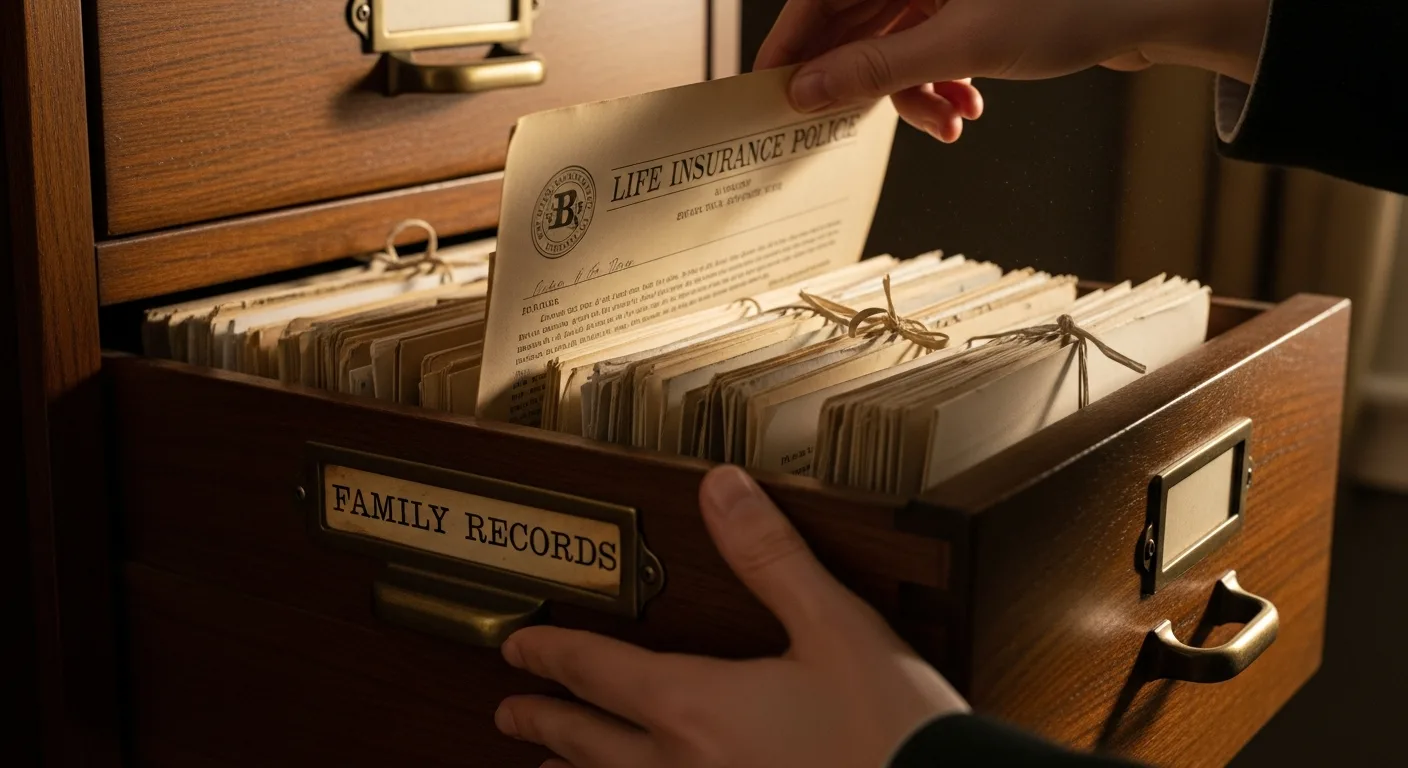
Start with the paper trail. Look through filing cabinets, a home safe, and any safety deposit box for policy documents, annual statements, or renewal notices from an insurer. Then check the money: bank and chequing statements often show a recurring premium payment, and credit card statements can reveal creditor life insurance or travel coverage bought through the card.
Next, think about where coverage tends to hide. Group life insurance through a current or former employer is easy to overlook, so contact the human resources department directly. Professional associations, unions, and alumni groups frequently offer member life coverage too. Any lawyer, accountant, or financial planner the person worked with may also hold a copy on file.
- Search personal papers, home safe, and safety deposit box for policy documents or insurer statements
- Scan bank and credit card statements for recurring premium payments
- Ask current and former employers' HR about group life insurance (including any tied to disability benefits)
- Check professional associations, unions, and alumni groups for member coverage
- Contact any lawyer, accountant, or financial planner who advised on the file
Searching for a deceased relative's policy
When someone passes away and the family suspects a policy exists but can't find the paperwork, there's a free national resource. The OmbudService for Life & Health Insurance (OLHI) runs a policy search: you submit a request, and OLHI forwards it to its member insurers, which contact you directly if they hold a policy on the deceased. Roughly 99% of Canadian life and health insurers are OLHI members.
There are limits worth knowing before you rely on it. The OLHI search is available where the death occurred within the past two years, it won't surface policies from the small number of non-member insurers, and it may not catch group coverage through an employer or association — which is why the employer and association checks above still matter. In Quebec, the Autorité des marchés financiers (AMF) offers its own search service for policies issued in that province.
Have the paperwork ready before you start. A search request and any subsequent claim generally need the deceased's full legal name, date of birth, date of death, last address, and an official death certificate. If you're the executor, insurers will also want to see proof of your authority to act on the estate. Gathering these first makes every later conversation faster.
- Submit a free policy search through OLHI (olhi.ca) — available within two years of death
- In Quebec, use the AMF search service for provincially issued policies
- Have ready: full legal name, date of birth, date and place of death, last address, death certificate
- Executors should also prepare proof of authority (probate or estate documents)
- Still contact employers and associations separately — group policies may not show up in a search
Unclaimed benefits and money left behind
Even after a policy is found, benefits sometimes go unclaimed simply because a beneficiary never knew to come forward. Canada has a few places to look for money that's been sitting idle. The Bank of Canada holds unclaimed bank balances — accounts and, in some cases, related funds left dormant for a long stretch — and its free online search lets anyone check by name.
Several provinces run their own unclaimed property programs for other assets, and the Bank of Canada's site links out to them. It's worth searching under the deceased's name, any former names, and common misspellings, because records are only as good as the way the name was entered.
If a search turns up an insurer but you hit a wall — a claim that stalls, a dispute over who the rightful beneficiary is, or an insurer that won't respond — OLHI can also help with complaints, free of charge and independent of the industry. It's a useful backstop when a legitimate benefit is being held up.
- Search the Bank of Canada's unclaimed balances registry by name (free)
- Check the relevant provincial unclaimed property program, linked from the Bank of Canada site
- Try former names and spelling variations when searching
- Use OLHI's free complaint service if a found policy's claim stalls or is disputed
Frequently asked questions
Sources
- How to find if a life insurance policy exists for a deceased person — OmbudService for Life & Health Insurance (OLHI)
- OmbudService for Life & Health Insurance — free policy search and complaints — OLHI
- Searching for insurance policies of a deceased person — Autorité des marchés financiers (AMF)
- Unclaimed balances registry — Bank of Canada
Licensed Canadian advisors and editors. We help Canadians compare quotes from 25+ vetted insurers — and we write the way we'd talk to a friend.