Canadian Healthcare vs U.S. Healthcare: Key Differences (2026)
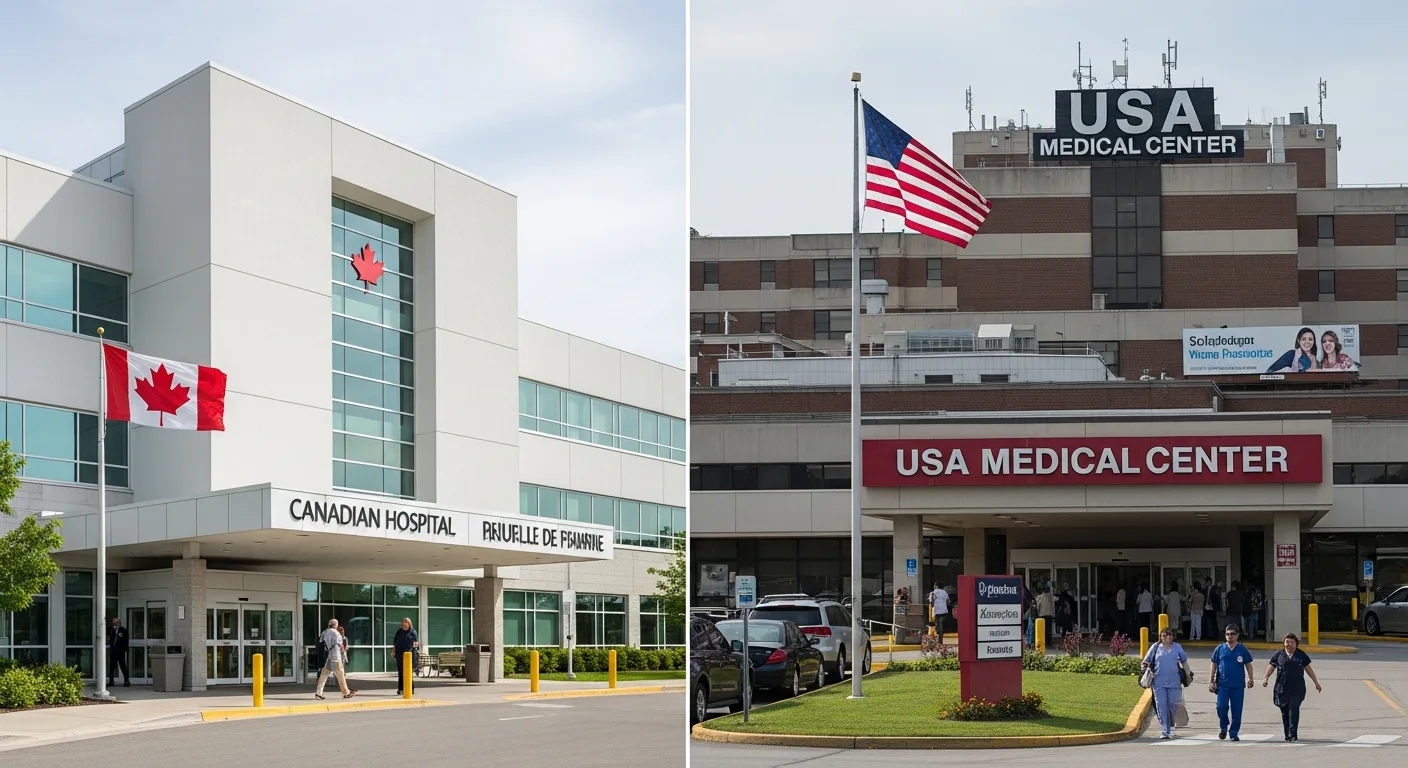
The fundamental difference: universal vs private-based
Canada runs a publicly funded, single-payer healthcare system. Every Canadian resident is enrolled automatically in their provincial or territorial health plan — no premiums, no deductibles, no insurance card to swipe at the emergency room. The government collects taxes and pays hospitals and physicians directly. If you break your leg in Calgary, the bill goes to Alberta Health Services, not to you.
The United States has no equivalent system for working-age adults. Americans access healthcare through a patchwork of employer-sponsored insurance, individually purchased private plans (via the ACA marketplace), and public programs: Medicare for seniors 65+, Medicaid for low-income households, CHIP for children, and Veterans Affairs for qualifying military. About 8% of Americans — roughly 26 million people — had no coverage at all as of 2024.
Confusingly, both countries use the word 'Medicare.' In Canada it refers to the publicly funded system covering every resident. In the U.S. it refers specifically to the federal program for adults 65 and older.
What Canadian provincial plans actually cover — and what they don't
Canada's provincial plans cover medically necessary hospital services, physician and specialist visits, and emergency care. No co-pays, no network restrictions, no prior authorization for covered services. The universality is real: a minimum-wage worker and a CEO have identical access to the same emergency room under the same rules.
What provincial plans do not cover is where the comparison to the U.S. becomes more nuanced — and where private insurance comes in.
- Prescription drugs: most provinces provide drug coverage only for seniors (65+) and social-assistance recipients. Working-age Canadians (25–64) typically pay out of pocket or through employer group benefits. Ontario's OHIP+ covers under-25s; Quebec's RAMQ provides baseline drug coverage to all residents, but at a cost.
- Dental care: not covered at any age by most provincial plans. The federal Canada Dental Benefit introduced partial coverage for children under 12 in 2022–2023, with expansion to broader groups underway — but comprehensive dental remains out-of-pocket for most adults.
- Vision care: routine eye exams are covered in most provinces only for children and seniors. Glasses and contacts are not covered at any age.
- Paramedical services: physiotherapy, massage therapy, chiropractic, occupational therapy, psychologists, and speech therapy are not covered except in limited circumstances (e.g., post-hospital discharge physiotherapy in some provinces).
- Private rooms: provincial plans pay only for ward-level hospital accommodation. A semi-private or private room costs $100–$300 extra per night.
- Out-of-country care: provincial plans provide minimal or no coverage for health emergencies while travelling abroad.
Free, private, no credit check. Average savings: $480/year.
Canada vs U.S. healthcare: by the numbers
Spending and access data tell different stories depending on what you're measuring. Key comparisons (OECD Health Statistics 2024, Commonwealth Fund 2024, Statistics Canada, U.S. CDC):
- Per-capita health spending: Canada ~$8,100 USD/year vs U.S. ~$12,500 USD/year — the U.S. spends 54% more per person
- Population covered: Canada 100% (universal) vs U.S. ~92% (private + public patchwork)
- Wait time — family doctor: similar in both countries (same day to 2–3 weeks)
- Wait time — specialist referral: Canada 4–20 weeks (varies by province) vs U.S. 2–6 weeks (with insurance)
- Wait time — elective surgery: Canada 8–40 weeks (provincial backlog) vs U.S. 2–8 weeks (with insurance)
- Life expectancy at birth: Canada 82.3 years vs U.S. 77.5 years
- Infant mortality rate (per 1,000 births): Canada 4.5 vs U.S. 5.4
- 5-year cancer survival rate (all cancers): Canada ~63% vs U.S. ~67% (U.S. advantage on some cancers due to faster screening)
- Risk of financial ruin from medical bills: Canada — very low; U.S. — medical debt is a leading cause of personal bankruptcy
“Canada's provincial plan is the floor, not the ceiling. Dental, prescription drugs, vision, and paramedical care aren't covered — private health insurance fills those gaps for about $80–$165/month.”
Pros and cons of the Canadian healthcare system
Canada's system is not objectively better or worse than the U.S. system — it makes different trade-offs that suit different needs.
- PRO — Financial protection: no Canadian faces bankruptcy because of a hospital bill. Medical debt is virtually non-existent as a personal finance problem in Canada.
- PRO — Portability: coverage follows you across jobs, across provinces, and in and out of self-employment. Losing your job does not mean losing your healthcare.
- PRO — Simplicity: no network confusion, no prior authorization for covered services, no explanation-of-benefits paperwork on routine care.
- PRO — Lower administrative cost: single-payer structure eliminates the billing complexity that accounts for roughly 30% of U.S. healthcare spending.
- CON — Wait times: elective procedures, specialist referrals, and diagnostic imaging (MRI, CT) regularly involve multi-week or multi-month waits in most provinces. Patients with life-threatening conditions are prioritized, which means non-urgent cases wait longer.
- CON — Drug coverage gaps: unlike many European universal systems, Canada's provinces do not provide universal prescription drug coverage for working-age adults. National pharmacare remains partial as of 2026.
- CON — Access variation by province: healthcare is administered provincially, so wait times, dental programs, and drug benefits vary significantly between Ontario, British Columbia, Alberta, and Quebec.
- CON — Limited private parallel delivery: most provinces restrict private pay alternatives to the public system, reducing competitive pressure on wait times and service quality.
Is Canadian healthcare better than U.S. healthcare?
For the majority of Canadians and Americans, Canada's system wins on two dimensions that matter most to most people: financial security and universal access. No one in Canada delays seeking care because they can't afford the copay. No one is uninsured because their employer doesn't offer benefits. The stress of medical debt — which affects tens of millions of U.S. households — is essentially absent in Canada.
The U.S. system performs better on speed and access for insured patients. An American with good employer coverage can often see a cardiologist within two weeks; a Canadian in the same situation might wait three to five months for a non-urgent specialist appointment. For certain cancers — particularly breast and prostate — the U.S. records modestly higher five-year survival rates, in part because of faster early detection through more aggressive screening protocols.
The honest answer is: it depends on your situation. If you are lower-income, self-employed, or between jobs, Canada's system is dramatically better. If you are a high-income earner with excellent U.S. employer insurance and you need fast specialist access, the American system can outperform on speed. For the median person, Canada's system eliminates catastrophic financial tail risk while accepting a moderate trade-off on elective-care wait times.
The coverage gaps Canadians still need private insurance to fill
Understanding what provincial plans don't cover explains why roughly 27 million Canadians — about two-thirds of the population — carry private supplemental health insurance alongside their provincial plan.
The average Canadian family spends $3,000–$5,000 per year out of pocket on dental care, prescription drugs, vision, and paramedical services that provincial plans don't cover. Private health insurance converts those unpredictable annual lump sums into a predictable monthly premium — usually far cheaper than absorbing the costs year over year.
The most common reasons Canadians buy individual private health insurance:
- Self-employment or contract work: no employer group benefits means no dental, no drug coverage, no vision benefit beyond the provincial floor.
- Leaving a job: group plan coverage ends on your last day. Applying within 60 days of leaving a group plan qualifies for guaranteed-issue plans (no medical questions) from carriers like Manulife FollowMe and Blue Cross.
- Early retirement: retiring before 65 means a gap in drug and dental coverage that provincial plans don't fill until you hit the senior threshold.
- Newcomers to Canada: most provinces impose a 3-month waiting period before provincial plan coverage begins. Private health insurance fills that gap.
- Chronic conditions with high drug costs: a specialty medication for rheumatoid arthritis, MS, or a cancer treatment can cost $2,000–$5,000 per month. Private drug plans with high maximums provide the financial buffer the provincial plan doesn't.
What private supplemental health insurance covers in Canada
Canada's private health insurance market operates entirely as supplemental coverage on top of the provincial plan — it does not replace it. Major carriers include Sun Life Financial (FlexCare), Manulife (CoverMe and FollowMe), Canada Life, Blue Cross (by province), GreenShield Canada, and Desjardins.
A mid-tier individual plan typically costs $80–$165 per month for a non-smoking adult and covers:
- Prescription drugs — 80–100% of costs after deductible, up to annual maximums of $5,000–$25,000 or unlimited on comprehensive plans
- Dental care — preventive cleanings twice per year plus basic restorative; major dental (crowns, bridges) included on higher tiers after a waiting period
- Vision care — $150–$400 allowance every 24 months for glasses or contacts, plus an annual eye exam
- Paramedical services — physiotherapy, massage therapy, chiropractic, psychologist visits; annual limits of $300–$1,000+ per discipline depending on the plan
- Emergency out-of-country medical — $5M+ in emergency coverage outside your province or Canada
- Hospital room upgrades — semi-private or private room above the ward rate
Frequently asked questions
Can Canadians use the U.S. healthcare system? Yes — as a private-pay patient or with travel insurance. Provincial plans provide almost no coverage outside Canada. Any Canadian planning extended time in the U.S. should carry emergency out-of-country travel medical insurance. The costs of uninsured U.S. hospital care can reach $30,000–$100,000 for a serious event.
Do Americans who move to Canada get universal healthcare? Yes — once the provincial waiting period (usually 3 months) is satisfied. Most provinces issue a health card after 90 days of residency. Private health insurance fills the gap during the waiting period.
Why do some Canadians go to the U.S. for care? Primarily for speed on elective procedures — hip replacement, cardiac surgery, certain cancer treatments — where Canadian public system waits exceed several months. The provincial system prioritizes urgent cases, so non-urgent elective care is where the wait-time gap is most pronounced.
Does Canada cover mental health? Psychiatric care provided by a physician or psychiatrist is covered by provincial plans. Psychologist and counsellor services are not covered provincially and typically cost $150–$250 per session. Many private health plans include $500–$1,000 per year in psychologist coverage.
Is Canadian healthcare really free? It is not free — it is pre-paid through taxes. The average Canadian household contributes approximately $6,000–$10,000 annually to publicly funded healthcare through income tax, HST, and other levies. The experience at the point of service is payment-free, which is what most people mean when they say 'free healthcare.'
Licensed Canadian advisors and editors. We help Canadians compare quotes from 25+ vetted insurers — and we write the way we'd talk to a friend.